
Ask a supplier “how do you control quality?” and you will usually hear about a final inspection and a certificate. In practice, quality in feeding products is decided long before the last carton is sealed—in how incoming material is verified, how the process is watched while it runs, and whether finished goods can be traced back to the batch that made them.
This page explains how quality control actually runs in a baby bottle factory, stage by stage, and what you as a buyer should verify rather than assume.
Why Quality Control Is a System, Not an Inspection
A single end-of-line check can only reject what is already wrong. It cannot prevent a colour mismatch caused by a substituted masterbatch, a dimensional drift caused by an unstable cycle, or a batch with no records that becomes untraceable if a complaint arrives six months later.
So a workable QC system has several gates:
- Incoming material verification
- In-process inspection during the run
- Assembly and function checks
- Final inspection before packing
- Traceability and record keeping
- Pre-shipment checks and documentation
Stage 1: Incoming Material Control
Everything downstream depends on what arrives at the loading bay. Incoming control typically covers:
- Grade and identity: confirming the resin matches the frozen specification, not a generic equivalent.
- Colour and masterbatch: verifying the colourant batch, because colour is part of the food-contact article and part of your approved sample.
- Documentation: material declarations and certificates filed against the batch received.
- Storage and drying: protecting material from moisture and contamination before processing, and drying where the polymer requires it.
A factory with strong supplier relationships has an advantage here—we work with 25 cooperative material suppliers, which makes it realistic to hold grades to specification instead of substituting whatever is available.
Stage 2: In-Process Inspection
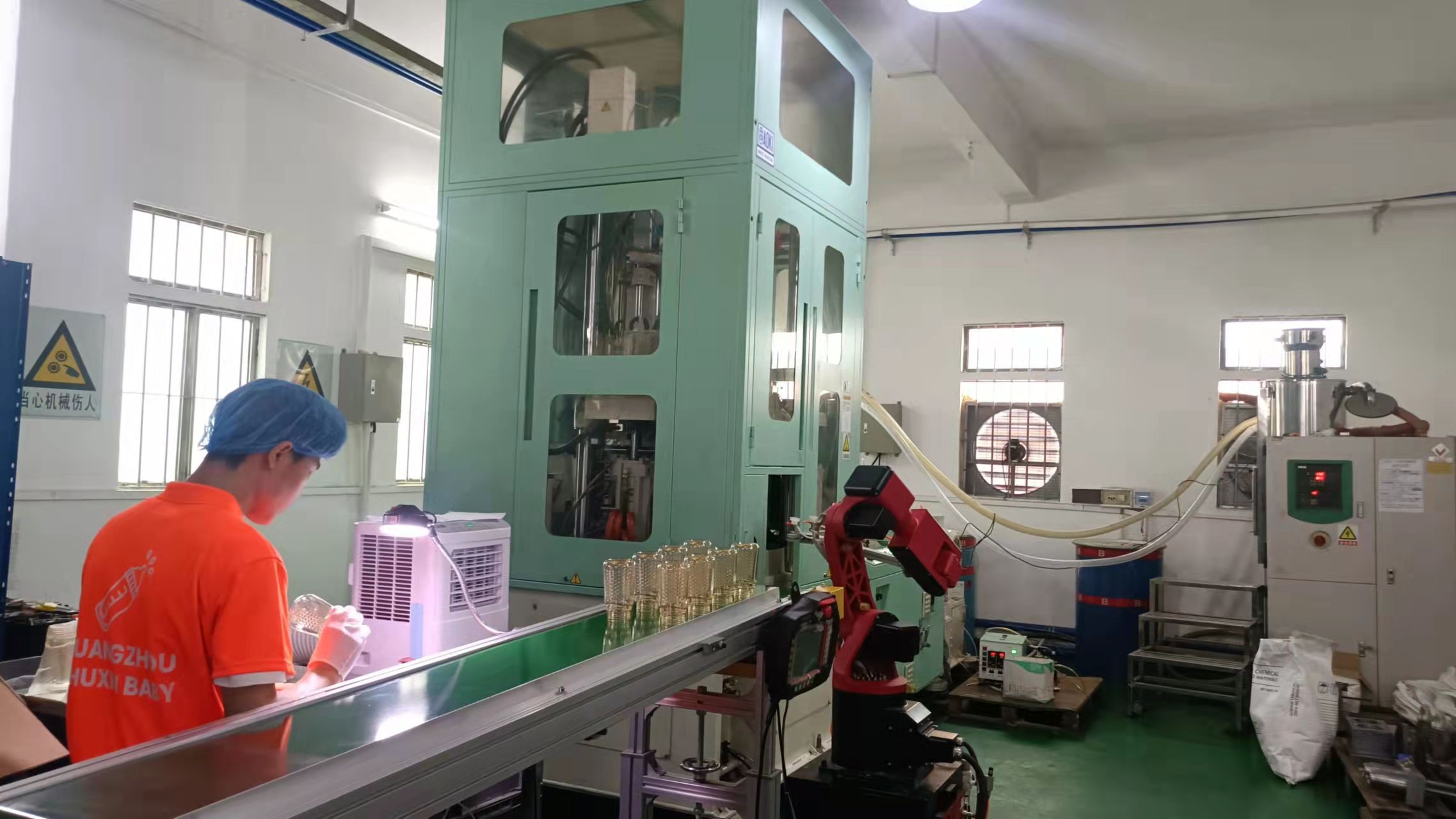
In-process inspection is where defects are caught while they can still be corrected. Typical checks during a moulding run:
- First-off approval: the first parts off a new run are measured and compared with the approved standard before the run continues.
- Dimensions and weight: wall thickness, height, thread and capacity checks at defined intervals.
- Appearance: flow marks, colour consistency, contamination, flash.
- Process stability: cycle time, temperature and pressure kept inside their windows—because drifting parameters produce drifting parts.
- Sample frequency: checks repeated through the run rather than once at the start.
Stage 3: Assembly and Function Checks
Once a bottle becomes a product—body, collar, teat, cap, valve or handles—the checks change from dimensional to functional:
- Leak testing: assembled units checked for leakage at the collar and any valve.
- Teat flow: verifying the flow rate matches the approved specification for that size.
- Fit and torque: collar engagement, cap security, and whether accessories assemble as designed.
- Impact sampling: drop checks on samples to confirm the assembly survives normal handling.
Teats deserve particular attention because they are a separate specification from the bottle—approving one does not approve the other, as we explain in our guide to sampling.
Stage 4: Final Inspection Before Packing
The last gate before goods leave the line covers:
- Sampling inspection against a defined acceptance plan, rather than “looks fine”.
- Verification of decoration, printing and label placement against the approved artwork.
- Checking packaging configuration—bulk cartons or retail sets—and carton counts.
- Confirming batch and lot coding is applied and legible.
Stage 5: Traceability and Records
Traceability is the part buyers appreciate only when something goes wrong. Good practice is a lot code that connects a finished carton back to the material batch, machine and production date, so a single complaint can be isolated to a specific run instead of triggering a full-range recall.
When you audit a supplier, ask to see a completed traceability record—not a procedure describing one. Our audit checklist lists the records worth requesting.
Stage 6: Pre-Shipment and Documentation
Before dispatch, a pre-shipment check confirms quantity, packing, labelling and general condition. Where you want independent verification, third-party inspection agencies can be engaged—and a factory that welcomes that arrangement is telling you something useful about its own confidence.
Alongside the goods goes the document pack: test reports and declarations for the parts produced, plus the records your market requires. The testing framework behind those documents is covered in food-contact testing.
Our Quality Control Arrangement
Our facility operates with 6 full-time QC inspectors working across production stages rather than a single final gate, and the plant is SGS verified, with certifications including FDA, CE, ISO 9001, EN 14350, CPC and CPSIA. Inspection responsibilities, records and reporting lines are described on our quality control page.
We describe this plainly because you should be able to test the claim: ask how many inspectors, at which stages, with what records—and compare the answers you get from different factories.
What Buyers Should Verify
| What to ask | Good answer looks like |
|---|---|
| Where is incoming material inspected? | A named person, with a record form and a specification to check against |
| What is inspected during the run? | Defined dimensions, frequency and acceptance criteria |
| How is a teat’s flow rate checked? | A measuring method, not “by eye” |
| Can you show a traceability record? | A real, completed lot record from a recent order |
| Who handles a complaint? | A corrective-action process with root cause analysis |
Common Quality Failures in This Category
- Colour mismatch between the approved sample and production, often from a masterbatch substitution.
- Flow-rate drift on teats when tooling wears or silicone parameters shift.
- Leaks at the collar from tolerance stacking between body and closure.
- Packaging and label errors that block retail intake even when the product is perfect.
- Missing batch records, which turn a small complaint into a large problem.
Frequently Asked Questions
Do you use AQL sampling for final inspection?
Final inspection is based on sampling with defined acceptance criteria agreed with the customer, rather than an informal judgement — and the criteria we use are stated in your order documentation.
Can we appoint our own third-party inspector?
Yes. Buyers frequently arrange independent inspection before shipment, and we support access and documentation for those visits.
How do you handle a defect discovered after shipment?
The lot code lets us isolate the affected run, identify the cause and define the corrective action — which is why traceability records are worth asking about before you order, not after.
The Bottom Line
Quality is the sum of several quiet decisions: verifying material on arrival, watching the process while it runs, checking function after assembly, inspecting before packing, and keeping records that connect everything together. Ask to see those records, and you will know more about a supplier than any certificate alone can tell you.
BebeFree manufactures PP, PPSU, glass and silicone feeding products for brands in more than 50 countries, with 6 full-time QC inspectors and an SGS-verified facility. See our quality control process or discuss an inspection plan for your order.
Related reading: Inside our baby bottle factory · How to audit a baby bottle factory · Food-contact testing explained · Lead time: capacity & peak season · How to read third-party test reports
Pingback: Silicone vs Latex Nipples: Hardness, Durability & Which to Choose
Pingback: Inside Our Baby Bottle Factory: 8,000 m², 6 Production Lines
Pingback: Beyond BPA-Free: Phthalates, Nitrosamines & Substances to Check
Pingback: Custom Bottle Colors & Logos: Pad Printing, IML & Decoration
Pingback: Nipple Flow Rates Explained: S, M, L, XL & When to Size Up
Pingback: When to Replace Baby Bottles & Nipples: Lifespan by Material
Pingback: Baby Bottle Production Lead Time: Capacity & Peak Season Planning
Pingback: How to Read Third-Party Test Reports: SGS, TUV & Intertek
Pingback: Hands-Free Feeding Bottles: Specifying, Sourcing and the 2026 Safety Bans - BebeFree