
Understanding how a baby bottle is actually made changes the questions you ask a supplier. Once you know what happens between a bag of resin and a packed carton, you can tell whether a price is realistic, why a lead time is what it is, and which quality claims are meaningful.
This guide walks through the production sequence step by step, with the equipment and the decisions behind each stage. It is written for buyers and brand owners rather than engineers—no machinery background needed.
Why This Matters to a Buyer
- Cost: mould cavity count, cycle time and material grade drive unit price more than labour does.
- Lead time: the tools, not the assembly line, are usually the bottleneck on a new project—see our OEM/ODM timeline.
- Consistency: whether a factory has automated take-out, in-process checks and traceable batches determines if container ten matches container one.
- Compliance: material handling and colour decisions made on the shop floor show up later in migration test results.
Step 1: Material Selection and Preparation
Feeding products are made from a small family of materials: polypropylene (PP), PPSU, silicone and glass, each with different cost, clarity, heat resistance and durability profiles—our material comparison covers how they differ in use.
Before moulding, resin is handled carefully:
- Drying: some polymers absorb moisture, which must be driven off before processing or the finished part shows streaks or weak spots.
- Contamination control: virgin material is kept separate from regrind, and food-contact parts have their own handling rules.
- Colour: masterbatch or pre-compounded colour is added in controlled ratios, because colour affects both appearance and test results.
These are the details buyers rarely see, and the ones that decide whether your test report still applies to the production run.
Step 2: Injection Moulding
Injection moulding is the core process: resin pellets are melted in a heated barrel and forced under high pressure into a precision steel mould, where the part cools and takes its shape. A moulding machine is built around:
- A hopper and feed section that meters pellets into the barrel.
- A screw and barrel that melt and inject the polymer.
- A mould mounted on platens, opened and closed by the clamping unit.
- A control system holding temperature, pressure and cycle time in tight windows.
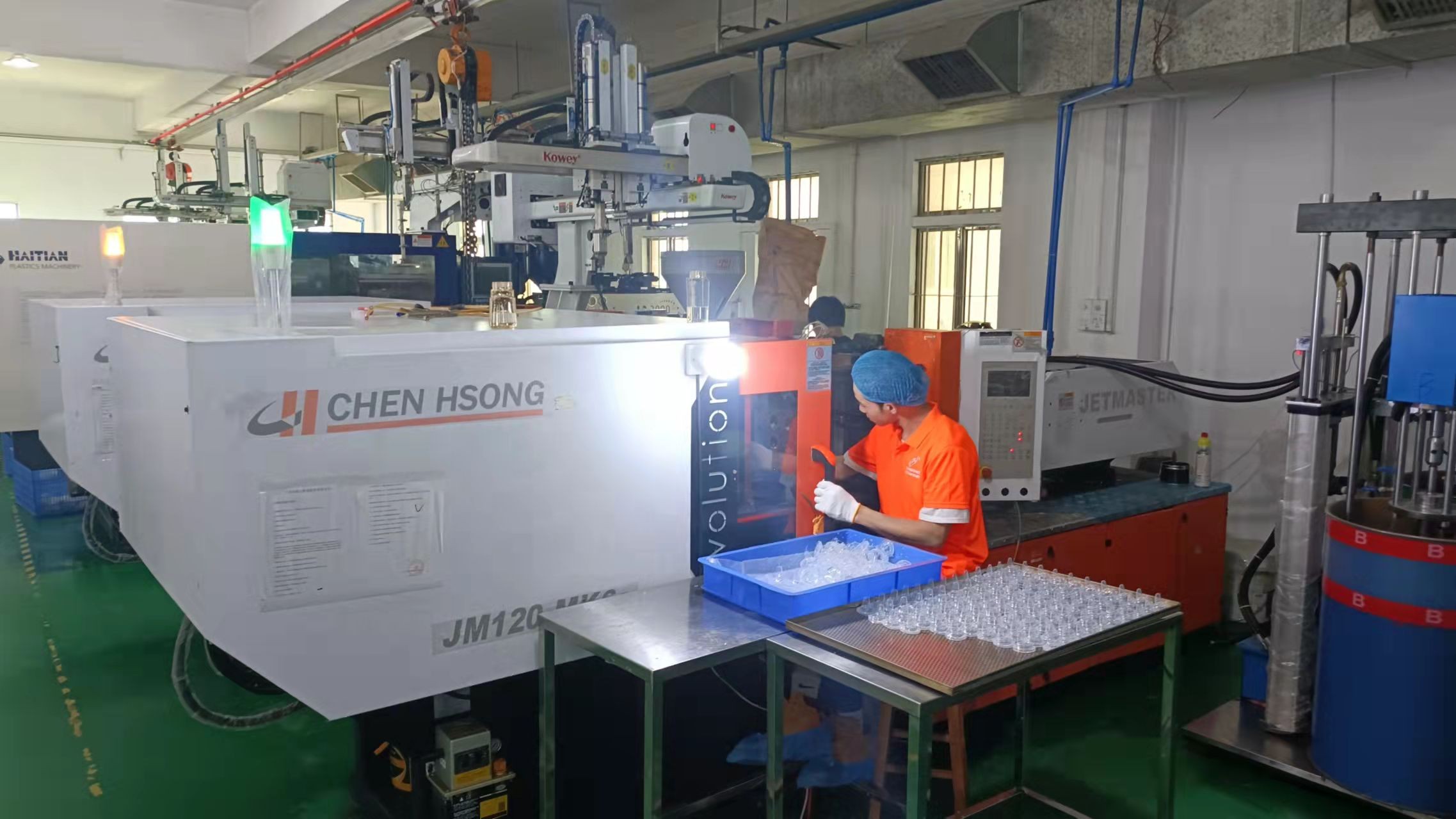
The cavity count of the mould—how many bottles are produced per cycle—is one of the biggest cost levers in the whole project. More cavities raise tooling cost but reduce unit cost at volume; fewer cavities keep the initial investment lower for smaller launches. This interacts directly with minimum order quantities.
PPSU and other high-temperature materials need tighter process control than standard PP, which is one reason not every factory quotes them.
Step 3: Robotic Take-Out and Cooling
When the mould opens, parts are removed—either by hand, by a simple sprue picker, or by a robot that places them onto a conveyor or into a controlled cooling sequence.
Automated take-out matters for three reasons: cycle times stay consistent, parts are not dropped or contaminated, and operators are kept away from hot mould faces. It is one of the visible signals of a modern plant, and one of the things to look for in a factory audit.
Step 4: Teats, Valves and Silicone Parts
Teats, anti-colic valves and soft components are a different production problem. Silicone parts are formed with their own tooling and process parameters, and their hardness (measured on the Shore scale), wall thickness and opening geometry define flow rate—the property that determines whether a teat feels right to a baby.
For buyers, the practical consequence is that a bottle and its teat are separate specifications. Approving one does not approve the other, and both belong in your sample approval.
Step 5: Decoration and Assembly
Most bottles are decorated after moulding, by pad printing, heat transfer or in-mould labelling, depending on design and volume. Decoration is a common compliance trap: the ink or film becomes part of the food-contact article chain and may need its own testing.
Assembly then brings together bottle body, collar, teat, cap and any handles or valves, followed by leak and function checks on samples from the line.
Step 6: Cleaning, Handling and Packing
Before packing, parts are handled to avoid dust and contamination, and packing is chosen by channel: bulk cartons for distributors, printed retail sets for brands.
Step 7: Quality Control Points
Quality control is not one inspection at the end. In a well-run plant it appears at several points:
- Incoming material: verifying resin grade, colour and documentation against the frozen specification.
- In-process: checking dimensions, weight and appearance during the run, not after it.
- Final: functional checks on assembled goods before packing.
- Traceability: batch and lot records connecting finished cartons back to material and machine.
Our own process is described on our quality control page, and the testing that sits behind material claims is covered in food-contact testing.
What This Means for Your Project
| Your decision | What it changes |
|---|---|
| Material (PP / PPSU / silicone / glass) | Unit cost, heat resistance, clarity, testing requirements |
| Mould cavity count | Tooling cost versus unit cost at your volume |
| Decoration method | Setup cost, lead time, additional compliance testing |
| Packaging format | Handling time, freight volume, retail readiness |
| Order quantity | Which price break and which mould payback you land on |
Frequently Asked Questions
How long does a single bottle take to mould?
The moulding cycle is measured in seconds to a couple of minutes depending on part size, wall thickness, cavity count and material. Project lead time, however, is dominated by tooling and approvals rather than the moulding cycle itself.
Why do quotes differ so much for a similar bottle?
Usually three things: material grade, mould specification (cavity count and steel quality), and decoration. A quote that does not name all three is not comparable — see how to read a manufacturing quote.
Can any factory make PPSU bottles?
PPSU demands tighter process control and higher processing temperatures than standard PP, so capability varies. Ask what grade they run regularly and request material documentation for your specific part.
The Bottom Line
Bottle manufacturing is a chain of controlled decisions: the right material handled properly, a mould specified for your volume, consistent cycle times, careful decoration, and checks at several points rather than one. Understanding the chain is how you compare suppliers on substance instead of on price alone.
BebeFree manufactures PP, PPSU, glass and silicone feeding products in our own 8,000 m² facility in Guangzhou, with 42 machines across 6 production lines and in-house mould development. See our OEM/ODM services or talk to our team.
Related reading: Inside our factory · OEM/ODM timeline · How to audit a baby bottle factory · Baby bottle quality control explained
Pingback: Inside Our Baby Bottle Factory: 8,000 m², 6 Production Lines
Pingback: Baby Bottle Manufacturing Timeline: Inquiry to Delivery