
Most buyers never see the plant that makes their product. They see a quotation, a sample and a tracking number. That is a lot of trust placed on a building they have never walked through.
This page is our attempt to change that: a walk-through of our Guangzhou facility—how it is laid out, what runs on the floor, how quality control is organised, and what you can ask us to verify.
The Facility at a Glance
| Item | Detail |
|---|---|
| Location | Guangzhou, Guangdong, China |
| Established | 2011 (as Guangzhou Shuxin Baby Products Co., Ltd.) |
| Facility size | 8,000 m² |
| Equipment | 42 high-precision machines |
| Production lines | 6 specialised lines |
| Annual output | 5,000,000 pieces |
| QC inspectors | 6 full-time |
| Material partners | 25 premium cooperative suppliers |
| Export markets | 50+ countries, with Southeast Asia, North America and Eastern Europe as primary regions |
| Verification | SGS verified; FDA, CE, ISO 9001, EN 14350, CPC and CPSIA certifications |
Why We Publish the Details
Factory capability is normally described in adjectives. We prefer numbers, because numbers can be checked—on a call, in a video walk-through, or during an audit. If you are comparing suppliers, the questions that matter are not “are you good?” but “how many machines, which materials, which certifications, and can I see them?”
How the Plant Is Organised
Material flow determines both quality and lead time, so the facility is laid out to keep the sequence short and controlled:
- Incoming material zone: resin received, identified and stored before use, with documentation checked against specification.
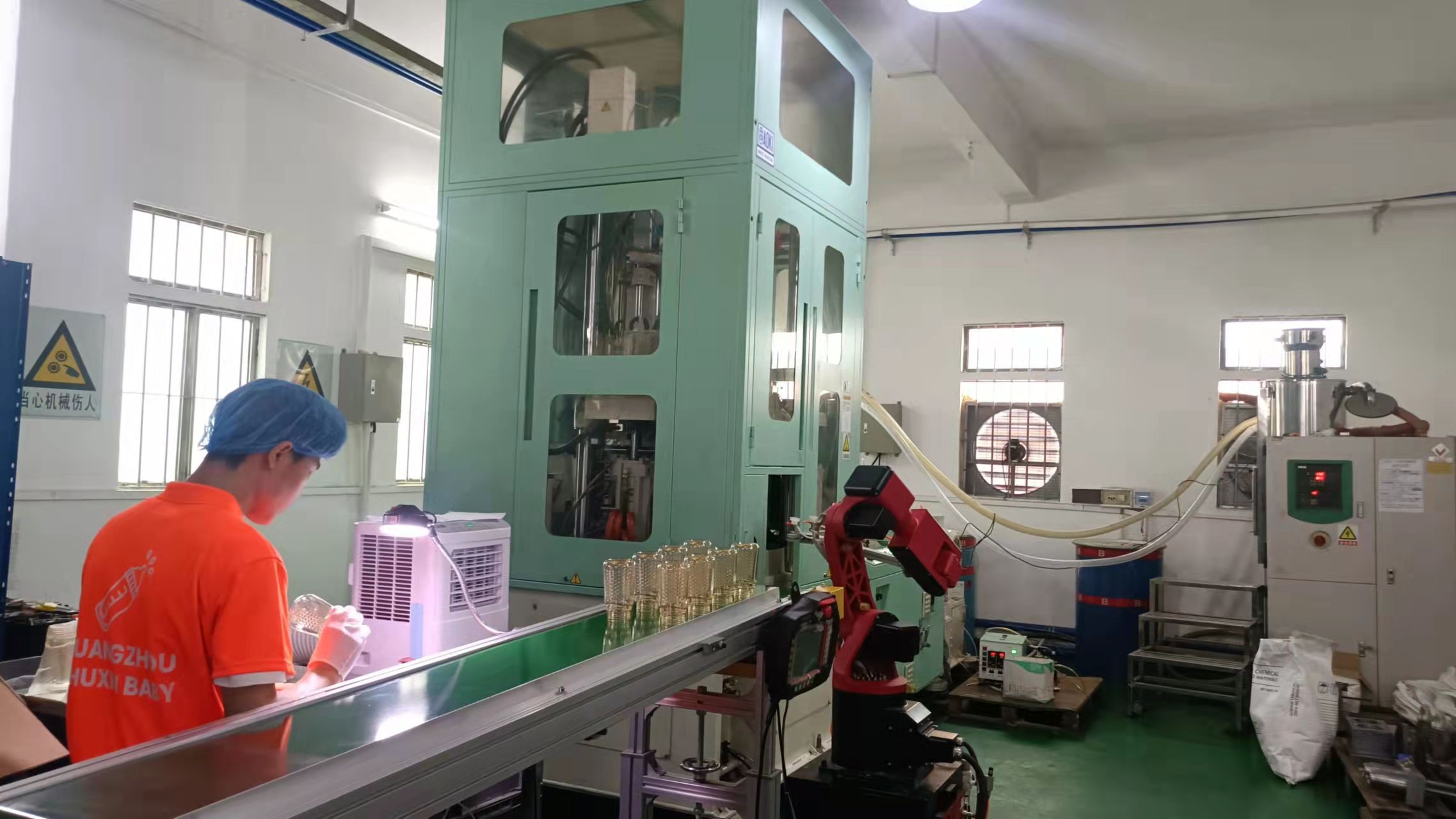
- Moulding area: 42 machines running across 6 production lines, with automated take-out on the modern lines.
- Assembly area: bodies, collars, teats, caps and accessories assembled to the approved configuration.
- Decoration and finishing: printing and decoration applied where the design requires it.
- Packing: bulk cartons or printed retail sets, depending on the channel you sell into.
In-House Mould Development
Our R&D centre was established in 2018 around our “Natural Feeding” philosophy—designing teats and bottles that mimic the mechanics of breastfeeding. Senior engineers lead 3D design, prototyping and precision mould development in-house.
Owning mould development on site shortens the loop between a design change and a new sample, and it means the people who cut your tooling understand the part. If you are commissioning a custom product, read our guide to mould ownership and IP protection before signing anything.
Quality Control, Stage by Stage
Six full-time QC inspectors work across the production stages rather than at a single final gate:
- Incoming: material grade, colour and documentation verification.
- In-process: dimensional and appearance checks during the run.
- Assembly: function and leak checks on assembled units.
- Final: inspection before packing, with batch and lot records retained for traceability.
The full picture is on our quality control page; the material testing framework behind our document set is explained in food-contact testing.
Capacity and Lead Time, Realistically
Annual capacity of 5,000,000 pieces describes the ceiling, not your timeline. Real lead time depends on tooling, material, decoration and quantity, and it is usually tooling that dominates a new project. We break the sequence down in our OEM/ODM timeline, so you can plan backwards from your launch date.
What You Can Ask Us For
- Test documentation and declarations for the specific parts we produce.
- Samples before you commit to production—see how sampling works.
- A live video walk-through of the relevant line, or specific station footage.
- Support during your own audit or third-party inspection.
- Mould ownership and storage terms in writing.
Our Story in Short
- 2011 — founded as Guangzhou Shuxin Baby Products Co., Ltd., focused on baby bottle manufacturing.
- 2015 — facility expansion and entry into the North American market.
- 2018 — launch of the “Natural Feeding” R&D centre.
- 2021 — exports reach 30+ countries across Europe and Asia.
- 2023 — consolidated international certifications including CPC, CPSIA and EN 14350.
- 2025 — exhibited at the HKTDC Hong Kong Baby Products Fair with a new BPA-free tableware series.
- 2026 — annual output reaches 5,000,000 pieces; returned to HKTDC with advanced breast pump innovations.
Our product range now covers baby bottles and nipples, breast pumps, pacifiers and tableware—see the full range. More background is on our about page.
Frequently Asked Questions
Can we arrange a live video tour?
Yes. For serious projects we arrange scheduled video walk-throughs of the relevant line, working around the production schedule rather than at a convenient but empty time.
Could we visit before placing an order?
Visits are welcome by appointment. If you are planning one, our audit checklist gives you a structure so you spend your time on the right things.
Do you produce for competing brands in the same category?
We work with brands across many markets. Where exclusivity matters, it belongs in the agreement—along with mould ownership and design terms.
The Bottom Line
An 8,000 m² plant with 42 machines, six production lines, in-house mould development and 5,000,000 pieces of annual output is not a claim you have to take on faith. Ask us to show you the line, the records and the documentation for your product. That is what a factory relationship should look like.
BebeFree has manufactured for brands in more than 50 countries since 2011. See our OEM/ODM services or start a conversation about your project.
Related reading: How baby bottles are made · How to audit a baby bottle factory · How to choose a manufacturer · Baby bottle quality control explained · Lead time: capacity & peak season
Pingback: Baby Bottle Quality Control: From Raw Material to Shipping